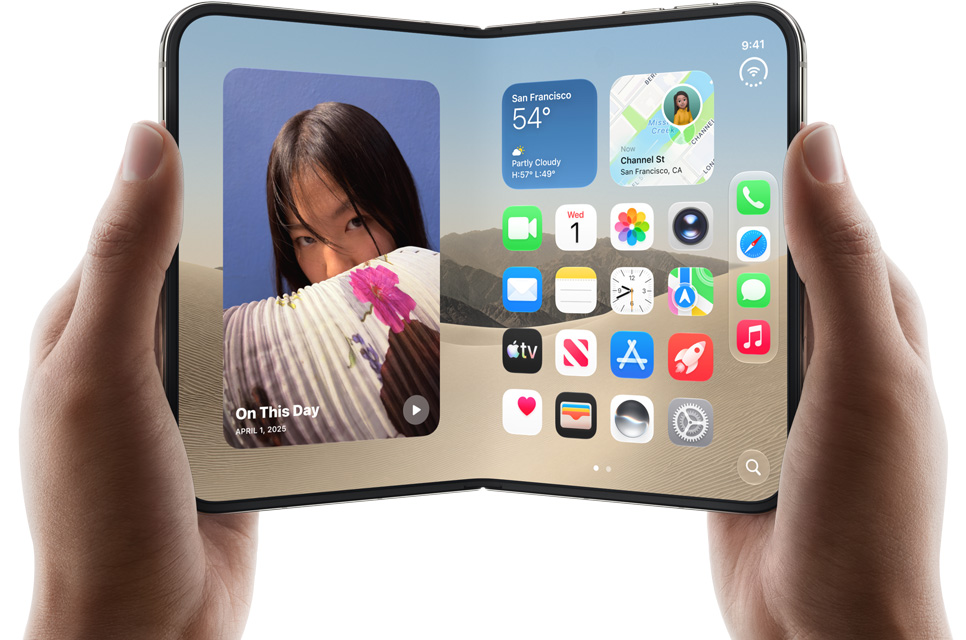
On September 10, 2026, Apple did something it had hinted at for years: it introduced the iPhone Duo, the company's first foldable iPhone. More than a new form factor, it is the most significant redesign of the iPhone since the original in 2007. This guide pulls together every spec Apple has published and explains, in practical terms, what the Duo actually is, how it compares to the rest of the iPhone family, and why it matters — especially if you buy, sell, or manufacture phone accessories.
The road to a foldable: why 2026
It is worth pausing on the timing, because it explains a lot about the product. Apple was not first to market — Samsung, Huawei, and others had shipped foldables for years — but Apple's pattern has always been to wait until a category's pain points are solved, then enter with a polished answer. The early foldables were criticized for three things: a visible, fragile center crease; hinges that collected dust and failed; and software that treated the big screen as an afterthought. By 2026, the underlying technology had matured enough — tougher ultra-thin glass, reliable multi-layer polymer stacks, sealed precision hinges, and mature split-screen operating systems — that Apple judged the moment right.
The Duo, read closely, is Apple's answer to each of those historical complaints. The nano-texture inner coating and sliding polymer layers attack the crease. The 100-part sealed hinge and IP68 rating attack fragility and dust. And iOS 27's Split View, app pairs, and matched dual displays attack the software awkwardness. In other words, the Duo is less a "first attempt" than a "we finally think we can do this properly" product — which is exactly the positioning that has historically let Apple dominate categories it entered late.
iPhone Duo at a glance
Before the long-form detail, here is the one-screen summary. The Duo is a book-style foldable: a normal-looking phone when closed, a small tablet when open. Apple's pitch is simple — the largest display ever on an iPhone that still slips into a pocket. If you only remember three numbers, make them 7.6, 5.4, and 5.2: a 7.6-inch inner screen, a 5.4-inch outer screen, and a 5.2mm-thin open body.
| Spec | iPhone Duo |
|---|
| Form factor | Book-style foldable (horizontal) |
| Inner display | 7.6-inch Super Retina XDR, 120Hz, up to 3000 nits |
| Outer display | 5.4-inch Super Retina XDR, 120Hz, Always-On |
| Chip | A20 Pro (TSMC 2nm), 6-core CPU / 7-core GPU |
| Memory | 12GB unified |
| Storage | 256GB / 512GB / 1TB / 2TB |
| Rear cameras | Dual 48MP (main + ultra-wide), no telephoto |
| Battery | Dual-cell; up to 44h video (outer) / 31h (inner) |
| Charging | USB-C fast charge (~50% in 20 min), 25W MagSafe, Qi2.2 |
| Build | Grade 5 titanium frame, Ceramic Shield, IP68 |
| Biometrics | Side Touch ID (no Face ID) |
| Weight / thickness | 254g; 11.3mm folded, 5.2mm unfolded |
| Price from | $1,999 (256GB) / ¥15,999 China |
| Availability | Pre-order Oct 16, 2026; on sale Oct 23, 2026 |
Design and build: titanium, a 100-part hinge, IP68
The frame, including the hinge cover, is made from Grade 5 titanium — the same aerospace-grade material Apple uses on the Pro lineup, chosen here for its strength-to-weight ratio. In a foldable, every gram matters twice: the device has to feel solid when closed yet disappear in the hand when open, and titanium lets Apple hit both targets without the heft of stainless steel. Foldables live or die by their hinge, and Apple's answer is a precision mechanism built from more than 100 individual components. An integrated magnet array helps the phone close securely and stay put, while a variable-torque design gives the lid a smooth, balanced resistance through the full arc of motion — open it halfway to use as a stand, and it holds.
Open, the Duo is just 5.2mm thin — thinner than many non-folding phones. Closed, it measures 11.3mm and weighs 254g. That is heavier than a slab flagship (an iPhone 18 Pro Max is around 227g), but Apple argues the trade-off is worth it: a 5.4-inch outer screen for quick tasks and a 7.6-inch canvas when you need room. Both front and back use Ceramic Shield; the outer display specifically uses Ceramic Shield 2, which Apple says is three times more scratch-resistant than the previous generation. The whole device carries an IP68 rating for dust and water resistance — a notable achievement for a moving, hinged product, and the first time a mainstream foldable has matched the ingress protection of conventional flagships.
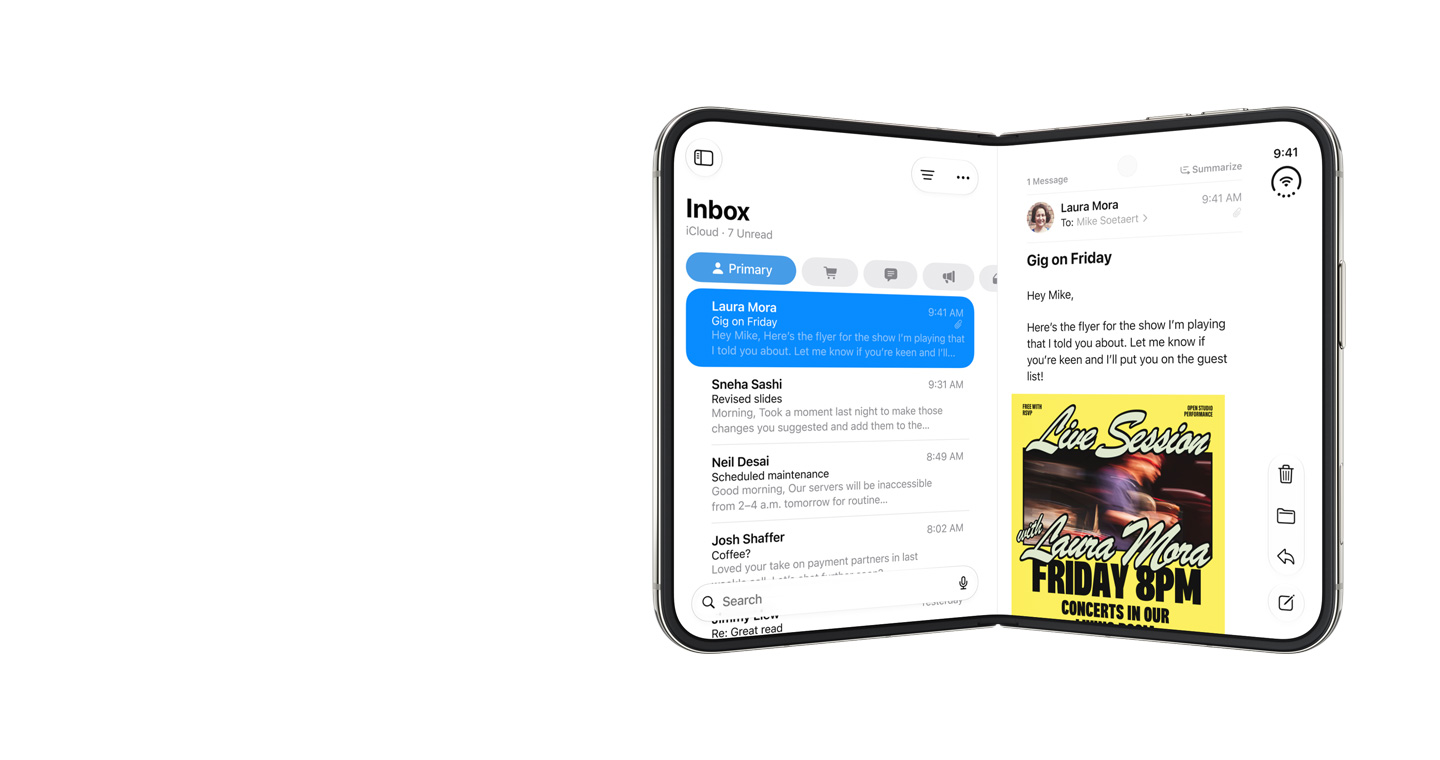
Durability was clearly a priority, not an afterthought. The inner panel uses a multi-layer construction of high-strength glass and a custom polymer coating, engineered so the layers slide relative to each other during folding and reduce long-term stress on any single point. Apple says this, combined with the nano-texture inner coating, makes the center crease far less noticeable than on earlier foldables — historically the single biggest complaint about the category. The hinge itself is sealed and rated to survive the kind of dust and grit that destroyed first-generation rivals.
Why does any of this matter to a buyer? Because a foldable's real cost is not the sticker price, it is the risk of the hinge or inner panel failing in year two. By leading with titanium, a 100-part sealed hinge, and IP68, Apple is explicitly targeting the perception that foldables are fragile. For resellers and wholesalers, that durability story is the difference between a return-rate nightmare and a premium, repeat-purchase category.
The two displays
The headline number is the 7.6-inch inner display — about 50% larger than the screen on the iPhone 18 Pro Max. It is a Super Retina XDR OLED with ProMotion (1–120Hz adaptive refresh), Always-On support, and a peak outdoor brightness of 3000 nits. Resolution is 1878 × 2670 at 430 ppi. To tame reflections, Apple applied a nano-texture finish — the same kind of anti-glare treatment found on its pro displays — across roughly ten ultra-thin layers. The result is a screen you can actually use in bright sunlight without a mirror finish staring back at you, and one that reads comfortably in a dark bedroom without searing your eyes.
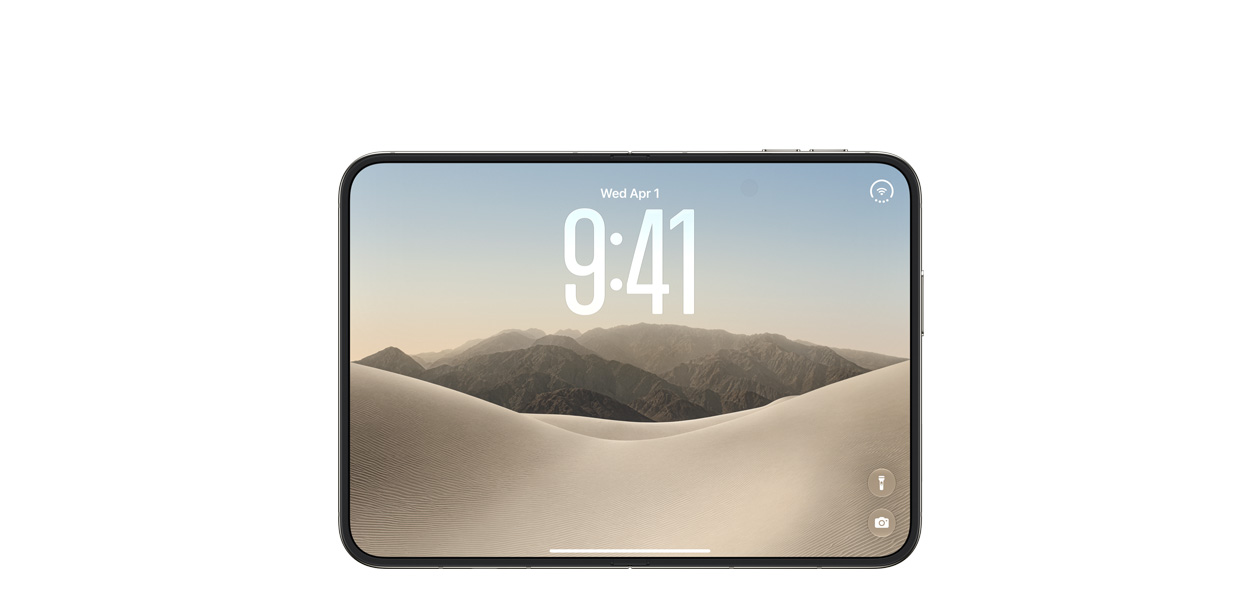
What makes the inner display special is the under-display FaceTime camera. Because the sensor sits beneath the pixels, the panel is uninterrupted — no notch, no punch-hole, no dynamic island cut into the canvas — when the camera isn't in use. It captures 1080p video and disappears into the display otherwise, which means full-screen video, games, and documents finally get the entire rectangle. For content creators and anyone who lives in split-screen, that unbroken surface is the whole point of a foldable.
The outer display is no afterthought. At 5.4 inches (1398 × 2034, 460 ppi) it is larger than you might expect — about 90% of the screen area of a standard iPhone 18 Pro. It, too, runs ProMotion at 120Hz with Always-On, so most everyday tasks — messages, maps, music, a quick photo, Apple Pay — never require opening the phone. Both displays share identical color calibration, so app content doesn't shift or stretch when you move between them, and the aspect ratios are matched so an app looks the same size, just on a bigger or smaller sheet of glass.
There is a subtle but important implication here for developers and accessory makers: because the two screens are color- and aspect-matched, apps that already support iPad-style multitasking translate cleanly to the inner panel. Apple is betting that the Duo won't suffer the "good outer screen, awkward inner screen" split personality that plagued some Android foldables, where the large panel felt like an afterthought.
Performance: the A20 Pro on TSMC's 2nm process
Power comes from the A20 Pro, built on TSMC's 2-nanometer process — the same chip family inside the iPhone 18 Pro models. The CPU has six cores and is up to 20% faster than the A19 Pro; the seven-core GPU is up to 40% faster and more power-efficient. Backing it up is a dual 16-core Neural Engine that doubles on-device AI compute, plus 50% more unified memory bandwidth for moving large assets around. The Duo ships with 12GB of RAM, enough headroom for split-screen multitasking, large photo libraries, and on-device Apple Intelligence features without aggressive memory pressure.
Sustained performance is where the Duo diverges from earlier foldables. Apple added a custom vapor-chamber (steam-chamber) cooling system so the phone can hold high clocks during gaming and long video sessions without throttling. Most phones benchmark well for thirty seconds and then fold under heat; the Duo's vapor chamber is explicitly there to keep the A20 Pro at full tilt through a 90-minute game or a 4K export. Apple claims up to 35% better sustained performance than the iPhone 17 Pro, which is a generational claim about endurance rather than just peak speed.
Connectivity runs through Apple's in-house C2 modem, with Wi-Fi 7, Bluetooth 6, and 5G, plus satellite messaging, Emergency SOS, and Roadside Assistance for off-grid use. The C2 modem matters because it is Apple's first widely deployed self-designed cellular chip after the Intel transition, and it is tuned for efficiency — useful on a device whose larger screens chew through battery faster than a slab.
Performance in context: the benchmarks that matter
Spec sheets love a raw Geekbench number, but for a foldable the metrics that actually predict satisfaction are different. The first is thermal endurance: a foldable running a big inner screen plus a sustained workload will heat faster than a slab, so the vapor chamber is doing real work, not just marketing. The second is memory headroom — 12GB means you can keep a video call, a notes document, and a browser with a dozen tabs resident while the inner screen is open, without the OS jettisoning your state. The third is modem efficiency, because Wi-Fi 7 and the C2 modem determine how long the battery lasts when you're actually using the connectivity the Duo is built to show off.
Put plainly: the Duo is not trying to win a one-minute speed test against a gaming phone. It is trying to stay fast and cool through the kind of 45-minute multitasking sessions that the large screen invites, and that is where the 2nm process, the extra memory bandwidth, and the vapor chamber compound into a noticeable difference. For buyers coming from a three-year-old slab, the gap will feel less like "20% faster" and more like "it never gets sluggish," which is the upgrade people actually feel day to day.
Cameras: dual 48MP with computational zoom
The rear system is a 48MP Dual Fusion pair: a 48MP main sensor (ƒ/1.6, with a 2× optical-quality crop) and a 48MP ultra-wide. Notably, there is no dedicated telephoto lens. Instead, Apple leans on computational photography for zoom, delivering up to 2× optical-quality output at 0.5×, 1×, and 2× focal lengths. That keeps the camera bump slim and the cost down while still covering the focal ranges most people use. It is a deliberate echo of the strategy Apple used on the non-Pro iPhone line: fewer physical lenses, smarter processing.
Video is a strong suit: 48MP stills, 4K Dolby Vision at up to 120fps, 1080p low-light capture, 4K Dolby Vision HDR timelapse, and Cinematic mode. On the software side, the foldable form factor enables tricks you can't do on a slab phone. Smart Take automatically captures a shot the moment the scene looks right. Duo Preview shows the subject a live preview on the outer screen so they can frame themselves — a small but genuinely useful feature for solo creators and parents. Kid Cue uses on-screen animation to grab a child's attention for the photo. Duo FaceTime lets the outer display join a group call while the inner screen stays on your content, so you can keep working while you talk. Photographic Styles 3, Spatial Reframing, and Clean Up round out the editing toolkit.
For selfies and video calls, the outer screen carries a 12MP Center Stage camera, while the inner display hides its FaceTime camera under the panel as described above. The practical upshot: you get a proper front camera on the outside for everyday selfies, and an invisible one on the inside for hands-free calls when the phone is propped open.
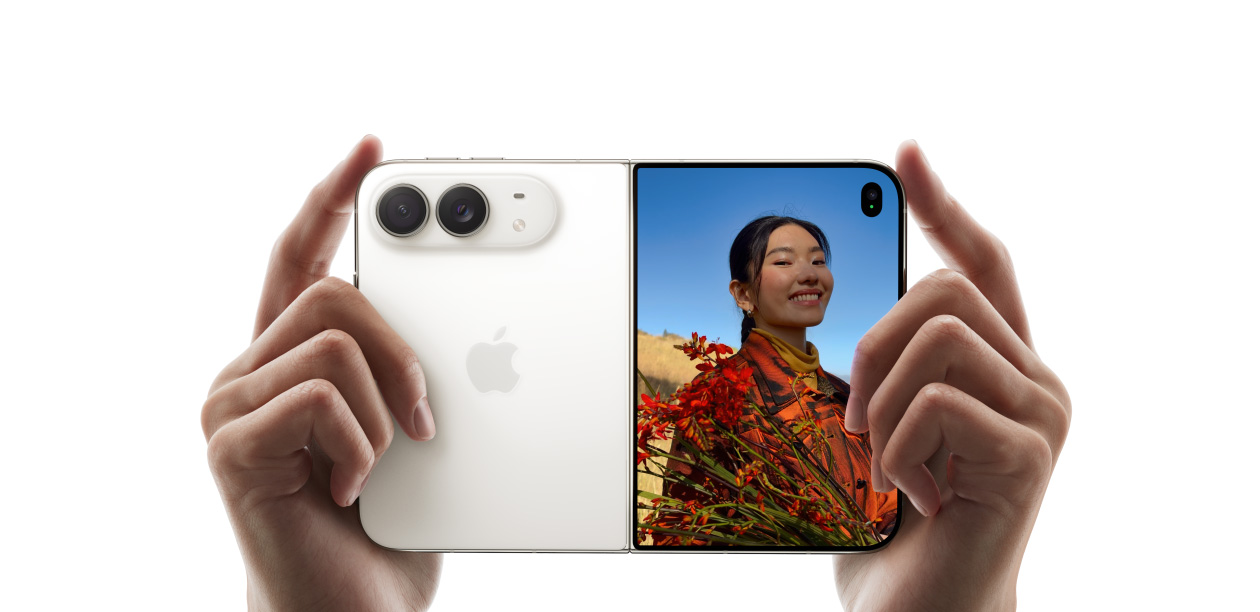
The omission of a telephoto will be the one spec-sheet knock against the Duo, and it is worth being honest about. If you shoot a lot of wildlife, sports, or staged portrait zoom, a Pro-model iPhone or a rival foldable with a periscope lens will serve you better. For everyone else — the overwhelming majority who mostly shoot at 1× and 2× — the computational approach is indistinguishable in normal use and keeps the device lighter and cheaper.
Battery and charging
Battery life on a foldable is unusual because it depends on which screen you use. The Duo employs Apple's first dual-cell battery system — one high-energy cell on each side of the device, managed by the silicon and power algorithms as a single system. Splitting the battery around the hinge is partly forced by the geometry and partly a smart thermal move: two smaller cells stay cooler than one large one wedged behind a folding panel. Apple rates video playback at up to 44 hours using the outer display and up to 31 hours using the inner display; with both screens used equally, it lands around 24 hours of mixed use per charge.
Charging is flexible. Wired USB-C fast charging is capable of reaching roughly 50% in about 20 minutes. Wireless MagSafe charging runs at 25W and is compatible with the Qi2.2 standard; Apple says you can hit about 50% wirelessly in around 30 minutes. For accessory makers and case designers, the MagSafe magnetic alignment is the detail that matters most — it is the same precise ring layout partners already build around, so existing pucks, stands, and car mounts line up exactly as they do on every other modern iPhone.
A useful mental model for buyers: the Duo's battery is tuned so that "phone mode" (outer screen) lasts about as long as a large slab iPhone, while "tablet mode" (inner screen) draws more because you're doing more. That is the honest trade of the category, and Apple has priced the dual-cell system to keep tablet-mode endurance respectable rather than class-leading.
Software and Apple Intelligence
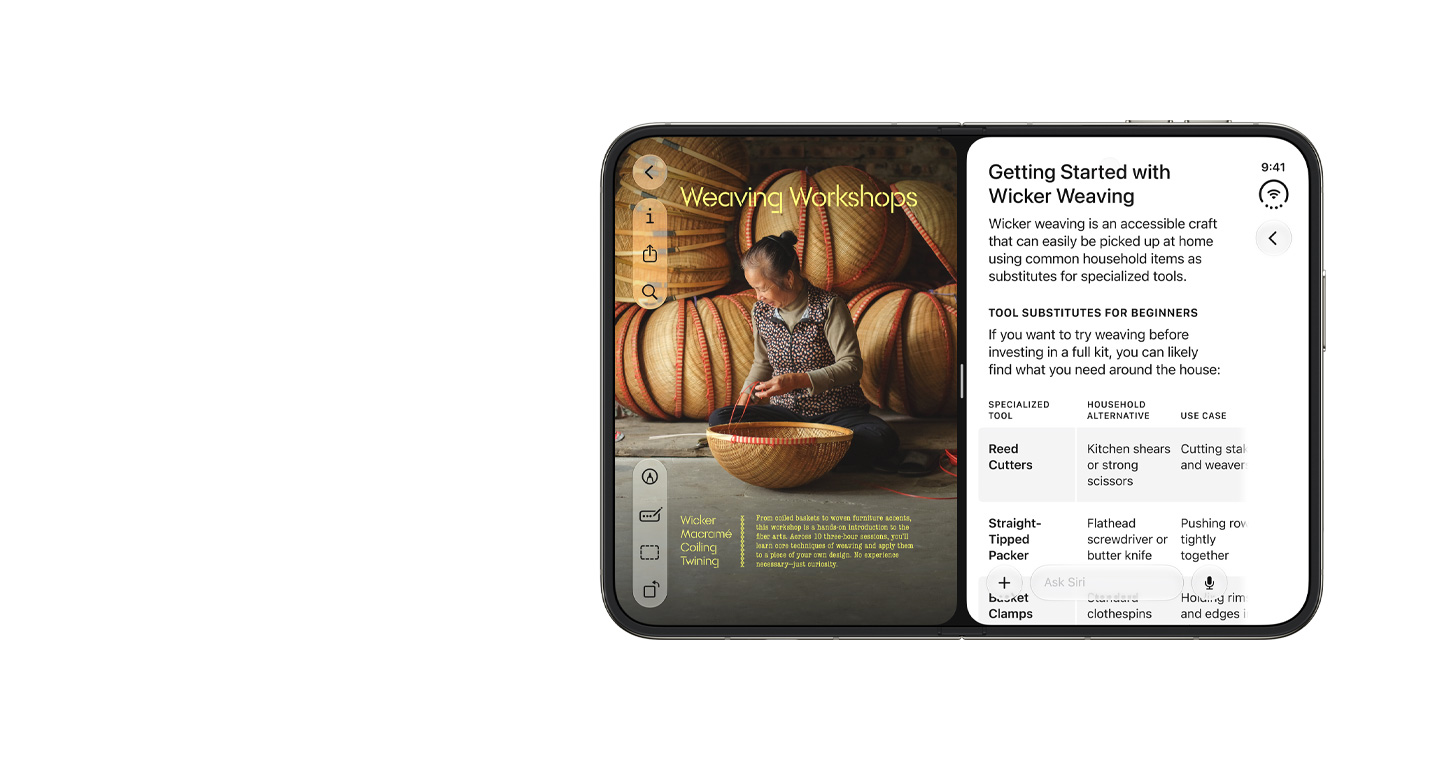
The Duo ships on iOS 27, which is where the hardware pays off. Split View brings true side-by-side apps and "app pairs" you can launch together; a folding phone finally makes multitasking on an iPhone feel natural rather than cramped. You can keep Maps open beside Messages, or Notes beside Safari, on a panel that is genuinely larger than an iPhone but smaller and more portable than an iPad mini. StandBy works even when the phone isn't plugged in, turning the outer screen into a bedside or desk clock when the device is folded into a tent shape.
Because the Duo drops Face ID in favor of a side-button Touch ID, unlocking is quick and works in any orientation — handy when the device is partially open, lying flat, or propped on a stand where a face scan would fail. For environments like kitchens, cars, and factories, Touch ID is arguably the better call, and its return is a quiet nod to function over fashion.
On-device Apple Intelligence is supported throughout: writing tools, image cleanup, notification summaries, and the broader Siri upgrades all run locally on the A20 Pro's Neural Engine. Apple emphasizes that the Duo's larger canvas and extra memory make these features feel less cramped than on smaller iPhones, and that on-device processing keeps personal data off the cloud — a privacy stance that doubles as a selling point for enterprise and regulated industries.
Durability, sustainability and the quiet details
Beyond IP68 and the titanium frame, Apple highlights a few quieter wins. The Duo is eSIM-only globally — there is no physical SIM tray — and the internal eSIM design frees space that helps the dual-cell layout fit. That also means travelers swap carriers with a tap rather than a paperclip, and it removes a common point of failure (the tray and its gasket). The phone supports Apple Pencil (USB-C), arriving later in the year, for annotating PDFs and sketching on the large inner display — a feature that finally gives the iPad-adjacent experience without the iPad.
In line with Apple's environmental goals, the enclosure uses 35% recycled material by weight, the manufacturing supply chain runs on 60% renewable electricity, and the packaging is 100% fiber-based. For procurement teams with ESG mandates, those numbers are increasingly a checkbox requirement in tenders, not a nice-to-have.
iPhone Duo vs the rest of the iPhone family
The obvious question for any buyer is: do I need a Duo, or is an iPhone 18 Pro enough? The honest answer depends on how you use a screen. The 18 Pro and 18 Pro Max remain the better choice if you want the absolute best single-camera system (including a dedicated telephoto), the lightest possible device, or the lowest price in the flagship tier. The Duo is for people who regularly wish their phone were bigger — for reading, for two apps at once, for video calls while taking notes — but who don't want to carry a separate tablet.
Against the iPhone Air, the Duo is heavier and more expensive but exponentially more capable as a productivity device; the Air wins only on thinness and weight. Against the standard iPhone 18, the Duo offers a dramatically larger canvas and more RAM, at a correspondingly larger price. The simplest framing: the Duo is the "pro plus" tier for screen real estate, sitting above the Pro models in price and ambition, below an iPad in size and cost.
Who should buy the Duo — and who shouldn't
Start with who it is for. If you routinely read long documents, annotate PDFs, run two apps side by side, or take video calls while you work, the inner screen will feel like a genuine upgrade rather than a gimmick. Creators who shoot and edit on the go benefit from the large canvas and the foldable-specific camera modes. Road warriors who live out of one bag will appreciate replacing both a phone and a small tablet with a single pocketable device. And anyone already deep in the Apple ecosystem will find the Duo simply extends habits they already have.
Now who should wait. If your phone lives in a rugged case on a construction site, the inner panel's long-term survivability under abuse is still an open question versus a slab. If you are a zoom-photography enthusiast, the missing telephoto will sting. If budget is the deciding factor, the Duo's $1,999 start is hard to justify against a $1,199 iPhone 18 Pro that does 90% of the same jobs. And if you simply never wanted a big screen — you prefer one-handed use and pocketability above all — the Duo's 254g folded body is a step backward from the featherweight end of the lineup. Being clear about these trade-offs is the responsible way to sell the category, and it builds the trust that turns a first-time foldable buyer into a repeat customer.
A day with the iPhone Duo
To make the specs concrete, imagine a typical day. You wake to the outer screen in Always-On StandBy mode on the nightstand — time, weather, and today's calendar at a glance, no unlock needed. On the commute, the 5.4-inch outer screen handles Maps and a podcast; you never open the phone. At the office, you prop it on a magnetic stand and run Mail beside a spreadsheet on the 7.6-inch inner panel, Touch ID letting you approve a purchase without rearranging your hands. At lunch you snap a photo of the group; Duo Preview lets everyone in the shot see the framing on the outer screen and fix it before you tap the shutter. In the evening, the inner display becomes a 7.6-inch TV for a downloaded episode, then folds away into a pocket-sized slab. None of these moments requires a tablet, a laptop, or a compromise — which is precisely the promise Apple is selling.
Pricing and availability
| Market / Tier | Price |
|---|
| US — 256GB | $1,999 (from $83.29/mo or $57.99/mo with Apple Upgrade) |
| China — 256GB | ¥15,999 |
| China — 512GB | ¥17,999 |
| China — 1TB | ¥21,499 |
| China — 2TB | ¥26,499 |
| India — 256GB | ₹2,99,900 |
| Colors | Star White, Night Sky |
| Trade-in | Up to $175–$885 (iPhone 13+), up to $290 (Android) |
| Pre-order | October 16, 2026 |
| On sale | October 23, 2026 |
At $1,999 to start, the Duo is the most expensive iPhone ever, and that price filters its audience. The financing math matters for wholesalers and carriers: at roughly $84 a month over two years, Apple is deliberately aligning the Duo with the "premium laptop" payment tier rather than the phone-tier impulse buy. Trade-in softens the blow — up to $885 for an iPhone 13 or newer, or $290 for a recent Android — and the Apple Upgrade plan drops the effective monthly to about $58, a clear play to normalize the price through subscription rather than sticker shock. For the accessory channel, a $2,000 device is good news: owners of expensive phones buy expensive protection and better mounts.
Why the iPhone Duo matters for accessory buyers
For a wholesale audience, the Duo is less a curiosity than a category signal. Foldables are moving from niche to mainstream, and that changes what sells. Three things stand out. First, MagSafe alignment is unchanged, so existing magnetic mounts, chargers, and wallets remain compatible — but the larger, heavier body and the hinged shape mean a mount designed for a 170g slab may not hold a 254g foldable as securely. That is exactly the gap our X01 foldable-ready holder is built to fill, with a wider clamp range and a stronger magnetic array tuned for two-screen weights. Second, the dual-screen life means cases must protect both a fragile inner panel and a traditional outer glass — a premium case opportunity with higher margins than single-material slab cases. Third, the eSIM-only design removes the physical SIM cutout from consideration for travel and carrier accessories, simplifying cross-border SKUs.
A practical note for buyers evaluating a universal foldable stand (the kind that works "whether the phone is open or closed") versus a dedicated magnetic car mount: the Duo's hinge is precise and its balance point shifts between folded and unfolded states. A passive stand that grips by friction may slip when the inner screen adds leverage; a magnetic mount that locks to the MagSafe ring is far more reliable in a moving vehicle. We covered this distinction in detail in our X01 compatibility guide, and the same logic applies to desktop and bedside stands.
In short: the Duo validates foldables as a volume category, and it rewards accessory partners who plan for heavier devices, stronger magnets, and hinge-aware protection rather than treating every phone as a thin rectangle. The brands that ship foldable-ready SKUs first will own the premium accessory shelf for the next two years.
Building a foldable-ready accessory lineup
If you stock or manufacture accessories, the Duo is a prompt to audit your catalog against four new requirements. Weight rating: re-test every mount and grip against a 254g device in both folded and unfolded states; many "universal" arms were validated against 180–200g slabs and will sag or creep under the Duo. Magnetic strength: keep the MagSafe ring alignment but consider a stronger array for car use, where vibration and cornering loads are higher than a desk puck ever sees. Hinge clearance: cases and sleeves must leave the fold mechanism unobstructed and must not press on the inner panel when closed; a case that adds even 0.3mm of pressure at the seam will accelerate crease wear. Protection tiers: offer a two-part story — a slim outer-shell for everyday and a rugged inner-panel guard for travel — because the failure modes of a foldable are different from a slab's.
The commercial upside is real. Foldable owners paid a premium for the hardware and are demonstrably willing to pay again for accessories that respect it; attach rates for cases, mounts, and screen-care on foldables run higher than on slab phones. The window to establish a private-label or OEM relationship on these SKUs is open now, ahead of the October launch, and the suppliers who show up with tested, foldable-specific products will capture the early premium margins before the category commoditizes.
Getting the most from the Duo: practical tips
A few habits make the Duo feel less like a fancy phone and more like the tool it is meant to be. Use the outer screen by default. For the first week most people over-open the device; in reality messages, maps, music, and payments are faster on the 5.4-inch outer panel, and saving the inner screen for when you genuinely need space preserves battery. Learn two app pairs. Program a "work" pair (Mail + Notes) and a "travel" pair (Maps + Translate) and you'll stop reconstructing your layout every time you open the phone. Lean on Touch ID. Because it's on the side button, you can approve purchases, unlock, and autofill passwords with a thumb while the inner screen stays focused on your task — something Face ID can't do when the phone is half-open on a stand. Prop it on a magnetic mount. The tent and landscape poses turn the Duo into a hands-free camera, a recipe display, or a video-call screen without a stand purchase. Shoot with Duo Preview. For group and kid photos, let subjects frame themselves on the outer screen; you'll get far fewer "redo it" moments. Keep the inner panel clean. A microfiber cloth and a gentle wipe beats any cleaner, and never let grit sit at the seam — that's the one place a foldable is vulnerable.
Common misconceptions
Three myths are already circulating, and it's worth clearing them up for anyone advising customers. "It's fragile." The Duo is IP68-rated and built around a sealed 100-part titanium hinge — more robust than the early foldables that earned the reputation, and on par with slab flagships for dust and water. "The crease ruins the screen." The nano-texture coating and sliding-layer construction make the center line markedly less visible than first-generation rivals; most users stop noticing it within a day. "It's just a small iPad." It isn't — it's a phone that occasionally becomes a tablet, and the software (Split View, app pairs, Always-On outer display) is tuned so you rarely need the big screen unless you choose to. Setting these expectations early reduces returns and builds the confidence that turns a curious first-time foldable buyer into a loyal one.
Frequently asked questions
Does the iPhone Duo support MagSafe?
Yes. It uses MagSafe wireless charging with Apple's magnetic alignment and is compatible with the Qi2.2 standard, so existing MagSafe accessories line up as expected.
Is there a telephoto camera?
No dedicated telephoto lens. Apple pairs a 48MP main with a 48MP ultra-wide and uses computational photography for up to 2× optical-quality zoom.
Does it have Face ID?
No. The Duo uses a side-button Touch ID for biometric unlock, freeing the inner display from a notch or punch-hole.
How big is it, really?
Closed it is 117.8 × 84.1 × 11.3 mm and weighs 254g; opened it measures 164.6 × 117.8 × 5.2 mm.
When can I buy it?
Pre-orders open October 16, 2026, with first deliveries from October 23, 2026, in Star White and Night Sky.
How long does the battery last?
Up to 44 hours of video on the outer screen, 31 hours on the inner screen, or about 24 hours of mixed use across both.
Is it water resistant?
Yes — it is rated IP68 for dust and water resistance, the first mainstream foldable to match conventional flagship ingress protection.
Which storage size should I choose?
256GB suits most users; 512GB is the safe default for those shooting lots of 4K video; 1TB and 2TB are for creators and travelers who keep large offline libraries.
Can I use an Apple Pencil with it?
Yes, it supports Apple Pencil (USB-C), arriving later in 2026, for annotating and sketching on the large inner display.
Will my existing iPhone case fit?
No. The Duo's foldable body and hinge require dedicated cases; standard iPhone cases will not fit. This is a fresh accessory category with its own SKUs.
Mount the iPhone Duo the right way
The X01 15W wireless holder is built for foldables — source it factory-direct.
View X01 →